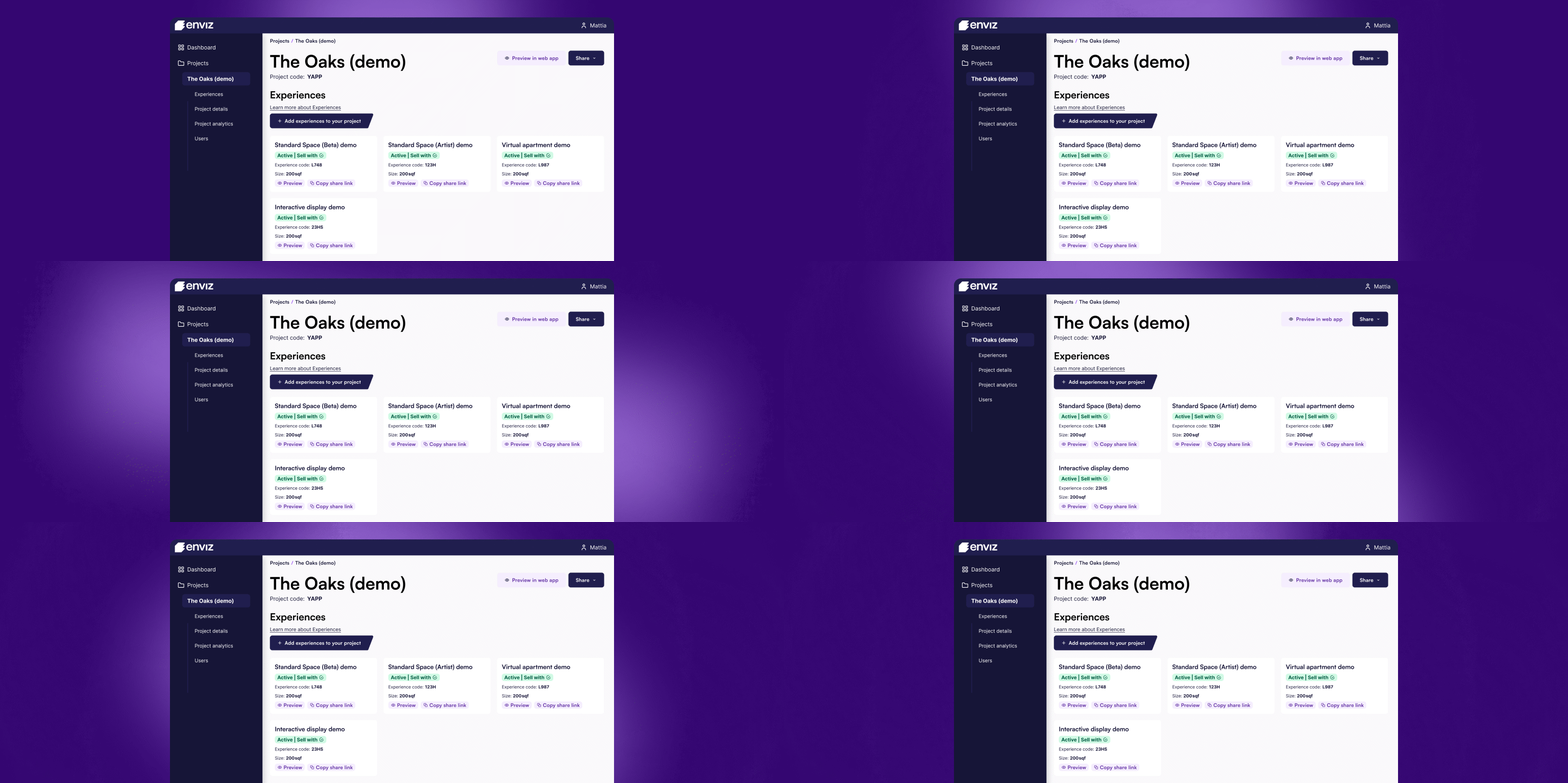
Enviz | Customer portal design
A customer portal for advanced Enviz users to create, manage, and publish AR and VR experiences.
01
Overview
Intro
Table of contents
Working closely with founders, and involving all the relevant departments (product, engineering, cx, sales) I defined all aspects of a digital product end to end, allowing advanced users to create, store, and manage multiple Enviz projects.
I also worked with a branding agency to implement a new visual identity through the digital product.
The product, referred to internally as ‘Customer portal’, enables a subset of the Enviz user base to convert their 3D files into fully interactive AR and VR experiences, and showcase them via a mobile app or on the web.
Structure
- H1 Summary
- H1 Design flow
- H3 Requirements gathering
- H3 Iterations
- H3 Artefacts
Table of contents
Summary
Working closely with founders, and involving all the relevant departments (product, engineering, cx, sales) I defined all aspects of a digital product end to end, allowing advanced users to create, store, and manage multiple Enviz projects.
I also worked with a branding agency to implement a new visual identity through the digital product.
The product, referred to internally as ‘Customer portal’, enables a subset of the Enviz user base to convert their 3D files into fully interactive AR and VR experiences, and showcase them via a mobile app or on the web.
The portal also functions as somewhat of an internal CMS where Admins – in a counterpart ‘Admin portal’ – can manage all aspects of the conversion workflows.
Design flow
For the Enviz project, I led a comprehensive requirements gathering process to align all stakeholders and define the project scope accurately, and transformed them into a clean experience to test with a small subset of users.
Requirements gathering
I kicked things off by organising a short series of workshops and one-on-one followup meetings with internal stakeholders, including the founding team, the main Product Manager, the Customer Experience leads, and all the internal technical experts covering VR and AR, to ensure that every perspective was captured early on.
I worked closely with the PM team to map out core product goals and constraints, focusing on understanding the business objectives and any existing tech. This collaboration helped identify essential features and prioritise user needs, ensuring the final solution aligned with strategic goals.
I spent the majority of the time with the Sales and CX team – whom I see as a shortcut to the users’ minds – to capture the customer’s voice and pain points. Their insights were crucial in shaping the user experience and determining which functionalities would provide the highest value.
Given the complexity of Enviz’s integration with advanced technologies like 3D modelling, VR, and AR, I also facilitated technical deep dives with subject matter experts in these fields.
This step was vital to understand the feasibility, technical specifications, and potential challenges in the perception of these immersive features.
Through these collaborative efforts, my PM counterpart and I were able to develop a detailed requirements document that balanced user needs, business goals, and technical feasibility, setting a strong foundation for project success.
Iterations
For the design phase, I translated the requirements into a highly functional prototype using Figma.
I started by creating an outline of the basic structure and flow of the product in a Notion document, focusing on core interactions, navigation patterns, and overall layout – to confirm the Information Architecture with all the stakeholders, and then quickly moved on to high-fidelity prototypes.
I used Figma’s prototyping features to simulate real-world interactions, making it easier for stakeholders to visualise the end product.
I presented these designs to key stakeholders, including PMs, CX leads, and technical experts to gather inputs on usability, functionality, and aesthetic alignment, ensuring that the designs resonated with both business goals and user expectations (still only via the CX team).
After incorporating feedback, I started evolving detailed UI elements and components, breaking things down to help the development for both backend and frontend teams.
The iterative process continued again and again — refining the designs based on stakeholder inputs until we achieved a balanced solution that satisfied both technical feasibility and user-centric design principles – the infamous MVP.
Artefacts
For this project, working asynchronously with an external engineering team, I decided to use a simple one-file structure.
This was crucial to allow multiple teams and stakeholders to both contribute to defining the UX, as well as for the engineering team to only have one place to look at.
Here’s a cleaned up version of the file. You can also see the live product signing up for a trial here: https://envisionvr.net/
03